
Why These Agencies Matter Early
From what we see on Selangor sites, late rework often starts with the Bomba requirements for factory buildings, or with the DOE and DOSH ones. Each agency watches a different risk:
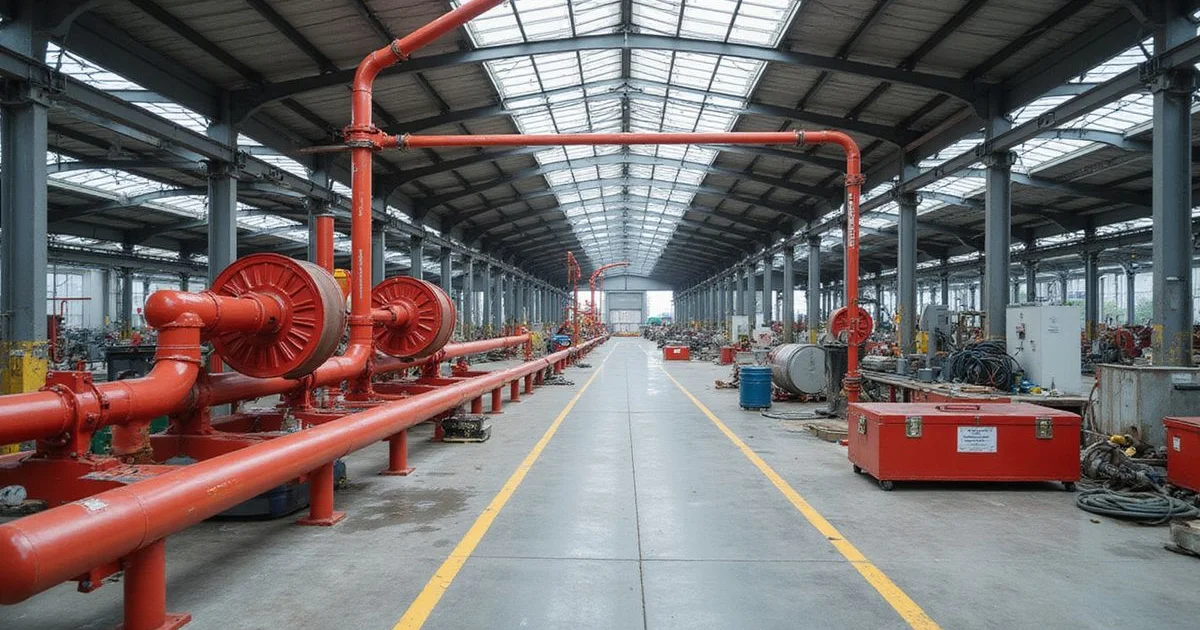
- Bomba (the Fire and Rescue Department) looks at fire
- The Department of Environment (DOE) looks at the environment
- The Department of Occupational Safety and Health (DOSH) looks at the safety of the people working in the building
The worry many owners have is failing a requirement late and having to rework the building. The good news is that most of these problems are avoidable if the requirements are raised during design.
Factory Builder Malaysia is the factory and warehouse building arm of QDB Ventures Sdn Bhd, a Cheras-based contractor that has been building in Selangor. If you are planning factory construction, this guide explains what each agency typically looks for.
Below, we start with Bomba’s fire rules, then cover DOE and DOSH, and finish with when to raise them and who is responsible.
Bomba: Fire Safety Provisions
Bomba reviews the fire safety of the building plans and inspects before the Certificate of Completion and Compliance (CCC). Typical provisions include:
- Escape routes and exits sized for the number of people
- Fire hydrants around the building, with access for fire engines
- Hose reels inside the building
- Sprinkler systems where the use, size, height or storage calls for them
- Fire compartments and fire-rated walls between areas such as office and production
Storage height and goods type have a big effect. A warehouse with tall racking of combustible goods may need far more fire protection than a light assembly factory. Our guide on warehouse sprinkler requirements goes into storage buildings.
Once the CCC is in hand, a second step starts: the Fire Certificate (Perakuan Bomba). Under section 28 of the Fire Services Act 1988, every “designated premises” needs one, and it is renewed every year. FactoryHub gives a sprinklered single-storey factory of 2,001 m² or more as one example of a designated premises, and the schedule was revised in 2020, so ask your engineers early whether your building falls in.
Here is what the Fire Certificate stage typically involves:
- Application through the SPKA portal. According to Get Foundation, you submit Form I with the CCC, the approved fire drawings and the commissioning reports.
- A fire safety management plan covering emergency procedures, maintenance and training.
- A fire safety team. FactoryHub, citing Bernama, reports that JBPM wants a Fire Safety Manager and three Fire Safety Officers for each designated premises, and will not issue an FC without them.
- Annual renewal. The certificate is valid for 12 months, so put the renewal date in your diary.
The numbers show why this matters. In August 2025, JBPM said 9,321 premises had been designated and only 5,881 held an FC. Astro Awani, reporting Bernama’s story, pointed to full enforcement from 2026 with fines of up to RM50,000, so build your fire team into the handover plan rather than leaving it until after.
DOE: Environmental Considerations
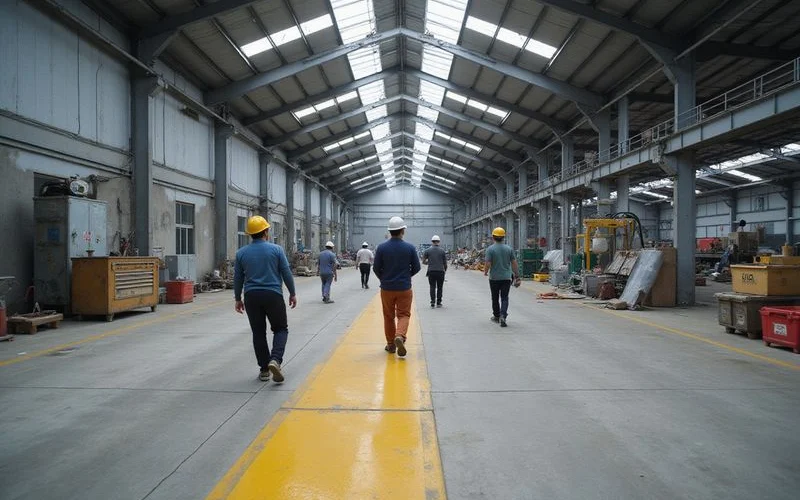
The DOE is concerned with what a factory releases into the air, water and ground. Whether it affects your building depends on your process. Points to think about:
- Air emissions from ovens, boilers, spray booths or dust-producing processes
- Effluent from washing, cooling or chemical processes
- Scheduled waste storage, which may need a dedicated, bunded area
- Noise affecting neighbours
If your process has any of these, the building may need treatment areas, extraction, bunding or space for storage. These are much easier to plan before the layout is fixed.
Here is how the main rules turn into building features:
- Scheduled waste: Connext Consulting notes that the Environmental Quality (Scheduled Wastes) Regulations 2005 list 77 waste categories. Containers must suit the waste, incompatible wastes must be kept apart, and lids stay closed. Law firm Azmi & Associates adds that storage is limited to 180 days or less, with no more than 20 metric tonnes on site, so size your store to match.
- Effluent: The Environmental Quality (Industrial Effluents) Regulations 2009 set Standard A or Standard B depending on where you discharge. Ion Exchange Global quotes typical Standard A limits of BOD 20 mg/L, COD 80 mg/L and suspended solids 50 mg/L, which is tight enough that you should leave real space for a treatment plant.
- Air: The Environmental Quality (Clean Air) Regulations 2014 apply to any premises used for industrial or trade purposes. Every premises must have an air pollution control system to the Director General’s specification, so allow for ducting, extraction and stack positions.
The stakes rose in 2024. Zul Rafique & Partners reports that the Environmental Quality (Amendment) Act 2024 came into operation on 7 July 2024. Fines for breaching licence conditions now run from RM25,000 to RM250,000, and jail terms stretch to five years. The Act also lets the Director General issue stop-work orders, which is the last thing you want halfway through a build.
Tell your engineers about the process, not just the building
The building’s fire, environmental and safety needs follow from what happens inside it. A clear process description is one of the most useful things you can share.
DOSH: Workplace Safety
DOSH covers the safety and health of people at work. For the building, that means safe access, ventilation, lighting, edge protection on mezzanines and platforms, and safe routes for people and forklifts. During construction, DOSH rules also govern the site itself, including working at height and lifting operations.
Three laws are worth knowing by name:
- Factories and Machinery Act 1967: The occupier notifies DOSH and submits particulars before running the factory. DOSH’s notification forms ask for a dimensioned sketch plan showing the machinery layout on each floor, plus washing and toilet facilities.
- Factories and Machinery (Building Operations and Works of Engineering Construction) (Safety) Regulations 1986: These cover safety during construction, which is why your contractor’s site practices matter to you as well.
- OSHA 1994, as amended in 2022: AmCham’s summary says the amendments took effect on 1 June 2024 and widened the Act to all places of work. Lexology adds that employers with five or more employees must appoint a safety and health coordinator where no safety officer is required, and that principals now owe duties to the contractors they engage.
| Agency | Main concern | Where it shows up in the building |
|---|---|---|
| Bomba | Fire | Exits, hydrants, hose reels, sprinklers, compartments |
| DOE | Environment | Extraction, effluent treatment, waste storage |
| DOSH | Workplace safety | Access, ventilation, edge protection, site safety |
Raise Them During Detailed Engineering
Raise all three agencies’ needs during detailed engineering, when the piping, mechanical and electrical design is worked out. That is when fire services, ventilation and drainage are designed, so including the agency needs then avoids rework later.
Timing matters most for Bomba. FactoryHub notes that fire installation drawings go to Bomba before the work starts, under UBBL by-law 245. Late changes to fire drawings can therefore hold up construction itself.
A short hand-over list helps your engineers get this right the first time:
- A written process description, including anything that creates emissions, effluent or scheduled waste
- Your machinery list and floor layout, which DOSH also asks for
- Storage height and goods type, since these drive sprinkler design
- Expected headcount, because exits are sized for the number of people
Our detailed engineering and M&E works service covers this stage. It is also why we ask about machinery and process early. Our guide on why machinery must be decided early explains the link.
Who Is Responsible?
Responsibilities vary by project. The design of fire protection is usually part of detailed engineering, while some licences and process-specific approvals stay with the owner.
For the Bomba Fire Certificate, Get Foundation describes a typical split like this:
| Item | Usually provided by |
|---|---|
| Fire safety plan drawings | Fire protection engineer or M&E consultant |
| Commissioning reports | Fire protection contractor |
| CCC | Principal Submitting Person |
| Form I and fire safety management plan | Building owner |
Whatever the split, it should be written down. Our quotations list who handles Bomba submissions, specialist installations and agency clearances, so nothing is left implied.
Send us your process description and site details, and we’ll mark up the Bomba, DOE and DOSH items before you sign anything. Sorting out the Bomba requirements for factory builds at this stage is the cheapest rework you will ever avoid.