What Is Detailed Engineering for a Factory?
Wondering what happens between your approved plans and the day the first machine switches on? That’s where detailed engineering and M&E (mechanical and electrical) works come in.
Detailed engineering covers the piping, mechanical and electrical design of your factory, scoped to the building design and how it will be used. Raise machinery and specialist equipment at this stage, because power, piping, drainage, ventilation and floor loading all depend on it.
As part of our factory construction work in Selangor, our team then installs the mechanical and electrical systems set out in the design. Deciding early avoids the rework that happens when equipment is chosen after the building is designed.
Here’s a simple habit that saves SME owners a lot of grief. Ask each machine supplier for a data sheet showing power rating, weight, and air, water and drainage needs before we finalise the drawings.
Our guide to what detailed engineering covers explains the drawings produced and where they sit in the project.
Why Does Machinery Drive the Design?
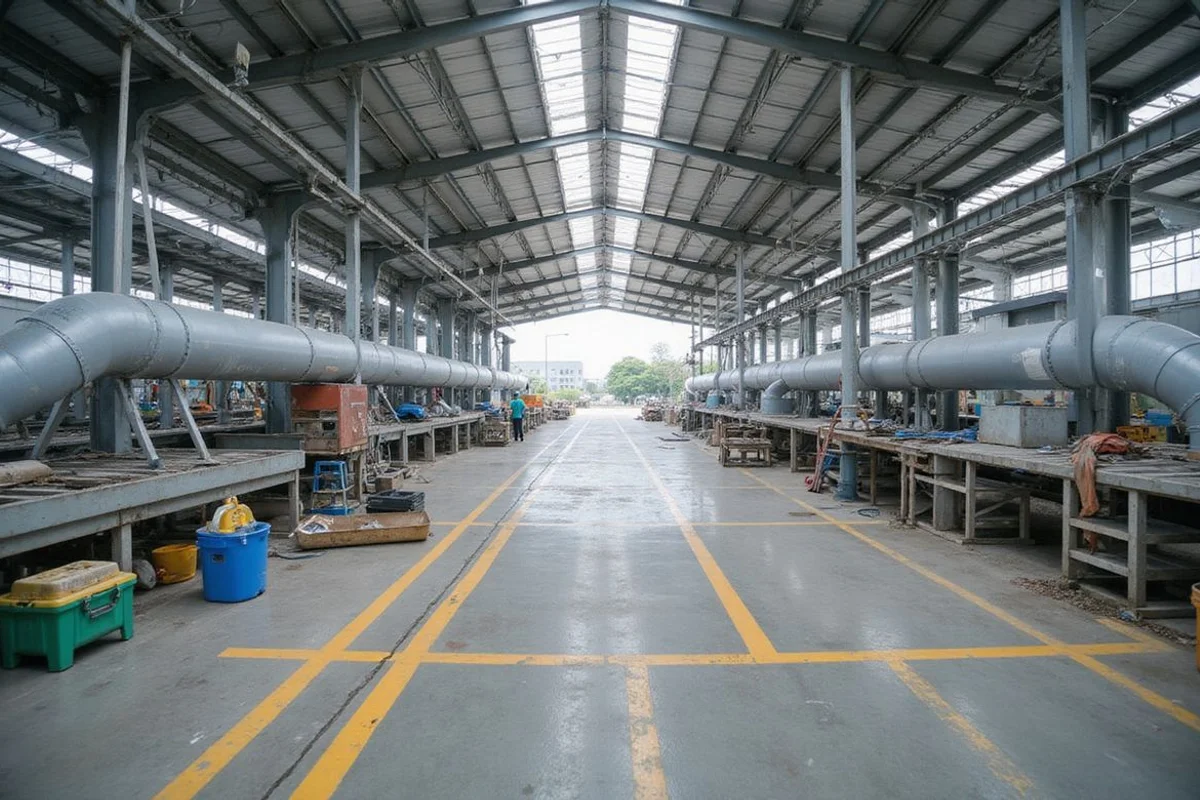
A factory’s services follow its machines. A press line, an oven or a compressor each brings its own needs:
- Power. Most factories need three-phase supply. Larger loads may need a substation. We size the distribution board and cabling from your equipment list. See factory power supply and TNB.
- Piping and drainage. Process piping, compressed air, water and process drainage are routed before the slab is cast.
- Ventilation. Heat, fumes and dust need extraction planned with the roof and walls.
- Floor loading. Heavy machines need foundations or thickened slabs at the right places.
The power line is where most SME owners get caught out. According to TNB’s Electricity Supply Application Handbook (ESAH 3.1), the maximum demand of your factory decides the supply scheme:
| Maximum demand | What TNB’s handbook says |
|---|---|
| Up to 72 kVA (100A) | Three-phase, four-wire, 415V supply |
| Up to 350 kVA | A new 11/0.4kV substation may be needed, subject to a TNB system study |
| Above 350 kVA, under 1,000 kVA | A new 11/0.4kV substation is required |
| 1,000 kVA up to under 5,000 kVA | 11kV supply, with 11/0.4kV and/or 11kV substations |
Treat this table as a guide only, because TNB confirms the final scheme for your lot. It does show why we ask for your equipment list early. A few extra machines can push you over the 350 kVA line, and that changes your land use, budget and timeline.
When these are decided late, floors get cut, drains rerouted and cables upsized. Our guide on why machinery must be decided early explains what to prepare.
When Do You Need to Plan for a Crane?
If your process uses an overhead crane, the building must be designed for it from the start. Crane loads go through the runway beams into the columns and foundations, and the hook height and span set the building height and grid.
The crane type also changes the structure. A top-running crane rides on rails on runway beams, which sit on the building columns or on separate crane columns. A 2026 design guide from PEB Steel notes that underslung cranes hang from the roof beams and suit lighter duty, typically 1 to 15 tonnes.
The crane itself comes from your specialist, but the structure is ours to get right. Tell us the crane type, capacity and span early, and we can size columns and foundations once instead of strengthening them later. See planning a factory building for an overhead crane.
Common Problems We Solve
- Not enough power for new equipment, solved with early load assessment and TNB power supply planning.
- Late machinery changes that would mean rework, avoided by asking for data sheets before design.
- Fire services added as an afterthought. Fire hydrants, hose reels and the sprinkler system where required are designed in. Under the Uniform Building By-Laws 1984 (amended 2021), every building needs at least one hydrant within 30 metres of its entrance. Sprinkler systems follow MS 1910.
- Utility connections left unclear. Air Selangor water supply and Indah Water sewerage connection responsibilities are written into the quotation. Air Selangor handles new development water applications through its eDPLAS system, so it helps to know who files what.
How Are M&E Works Priced?
M&E is quoted after detailed engineering, as part of the project quotation. The main cost drivers are your power demand, the amount of process piping and drainage, ventilation needs and fire services.
We do not publish a price list. The quotation lists inclusions, exclusions and responsibilities, including who handles utility applications.
Ready to see what your machines mean for power, piping and fire services? Send us your equipment list, and we’ll show you how detailed engineering and M&E works fit your factory before any price is set.