
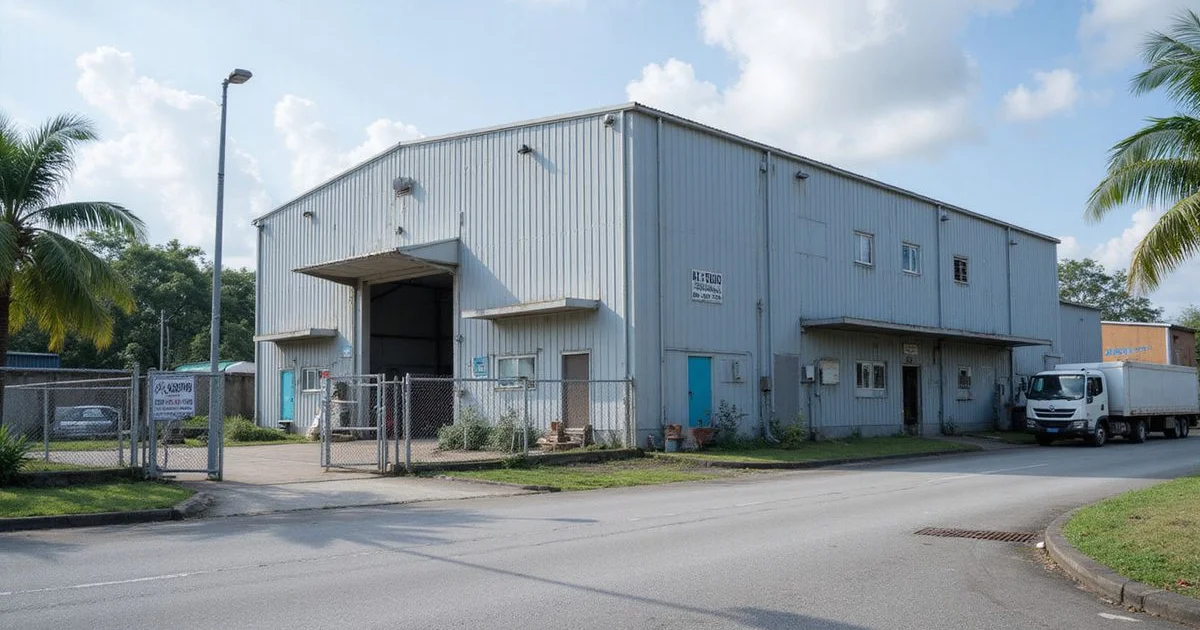
Power Shapes the Factory
You know how most first-time factory owners start with the building and leave the factory power supply from TNB for later? That’s usually where the schedule slips.
For many factories, power is the single biggest engineering question. It decides the size of the incoming supply, whether a substation is needed, how big the electrical room is and how cables reach each machine. It also has its own approval timeline.
At Factory Builder Malaysia, the factory and warehouse building arm of QDB Ventures Sdn Bhd, a Cheras-based contractor building in Selangor, we plan power early in our M&E works. The reason is TNB’s own clock. According to TNB’s Electricity Supply Application Handbook (ESAH), a 400V supply that needs a new substation typically takes 3 to 12 months, and only if local authority approvals don’t hold things up.
Below, we cover three-phase supply, how to estimate your load, when TNB asks for a substation, where the application sits in your timeline and who handles each step.
Three-Phase Supply
Industrial machinery generally runs on three-phase power, which delivers more power more efficiently than single-phase. Vertiv notes that a three-phase system can deliver nearly twice the power of single-phase without needing twice the wires, and the power stays steady instead of pulsing.
Most factories need a three-phase supply from TNB. Inside the building, it’s distributed through a main switchboard and sub-distribution boards to each area and machine.
TNB’s supply options step up as your load grows:
| Maximum demand | TNB supply |
|---|---|
| Up to 72 kVA (100A) | Three-phase, four-wire, 400V |
| Up to 1,000 kVA | Three-phase, four-wire, CT-metered, 400/230V |
| 1,000 kVA to 5,000 kVA | Three-phase, three-wire, 11kV |
Most factories cross that 100A line quickly. Once you do, the ESAH asks you to appoint one Electrical Consultant Engineer for each supply application, so build that cost and step into your plan from day one.
Estimating Load From Equipment
The size of the supply comes from the total load: everything that uses power, adjusted for what runs at the same time. TNB plans around your maximum demand, which is the highest load your factory draws, declared in kVA or kW.
| Load type | Examples |
|---|---|
| Process | Machines, compressors, ovens, chillers |
| Building | Lighting, fans, extraction |
| Office | Air-conditioning, IT, small power |
| Future | Machines you plan to add |
We build this from your equipment list. The “adjusted for what runs at the same time” part is called diversity. One worked example from CalcPanel’s diversity factor guide compares 682 kW of connected load with a 491 kW metered peak, a ratio of 1.39, because not every machine runs at full rating together.
Getting the number right matters for two reasons:
- Low-voltage connection charge: According to FactoryHub’s 2026 factory cost guide, TNB’s charge runs from RM4,050 (61 to 90 kW) to RM38,250 (721 to 850 kW).
- Medium-voltage penalty for over-declaring: TNB charges RM45 per kW of maximum demand. It also bills RM8.50 per kW for any shortfall between your actual and reference maximum demand.
Allowing for growth now is far cheaper than upgrading the supply later. List future machines honestly, though, rather than padding the number “just in case”.
When a Substation Is Needed
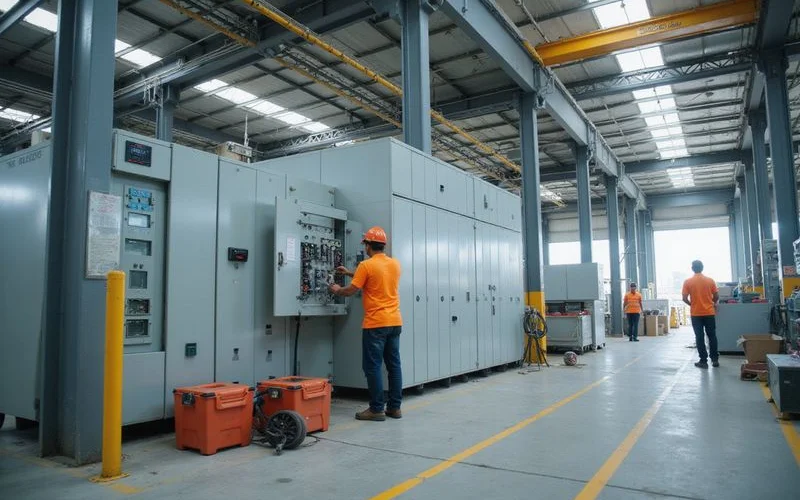
TNB requires a new 11/0.4kV substation once your maximum demand passes 350 kVA, which is about 505A at 400V. Between 100 kVA and 350 kVA, TNB decides after a system capability study.
When the load passes what the local network can supply directly, TNB may require a substation on or near your site. A factory substation in Malaysia needs space, access for TNB, and its own building or compound. It affects the site layout, so it needs to be known before the layout is fixed.
| Maximum demand | Substation under ESAH 3.1 |
|---|---|
| Up to 350 kVA | May be required, subject to TNB’s study |
| Above 350 kVA to below 1,000 kVA | Required: a new 11/0.4kV substation |
| 1,000 kVA to below 5,000 kVA | 11kV supply, and a new main substation (PPU) may be required |
For the layout, these are the points to plan around:
- Footprint: TNB’s standard land size for a compact substation unit (CSU) is 5m x 7m, and it must still meet local authority setback rules.
- Capacity: A CSU for commercial and industrial use tops out at 1,000 kVA.
- Position: TNB’s guidelines say a compact substation should sit close to the load centre.
- Land ownership: The ESAH asks you to transfer or lease the substation land and building to TNB for a nominal RM10. Delays in title transfer can hold up the project, so as a landowner, sort this early.
Leave space for a substation if there is any chance you need one
Finding room for a substation after the layout is fixed can mean redesigning parking, loading or landscaping.
The TNB Application in the Timeline
The TNB application for your factory, and any substation work, run on TNB’s timing, not the contractor’s. If left late, the building can be finished but not fully energised, which delays handover and the CCC.
TNB’s ESAH gives these typical supply project lead times:
| Supply level | Typical lead time |
|---|---|
| 400V and below, no substation | Under 3 months |
| 400V and below, with substation | 3 to 12 months |
| 11kV | 6 to 12 months |
| 33kV | 18 months to 2 years |
These figures assume no delay in local authority approvals. TNB’s Customer Charter also commits to commissioning supply up to 33kV (with substation) within 4 months. That clock starts only after you pay the connection charge, hand over the substation and make the site ready, so a late substation building holds everything up.
The sequence for a load above 100A looks like this:
- Appoint an Electrical Consultant Engineer to act for you.
- Submit the application with your load details.
- Complete TNB’s technical and financial approval, including the connection charge.
- Build the substation to TNB’s specification and hand it over.
- Have your electrical contractor submit the meter application, then TNB installs the meter and energises the supply.
We raise the power application early so it runs alongside design and construction. Our guide on how long it takes to build a factory shows how utilities fit the programme.
Who Handles What
Responsibilities for power are listed in the quotation: who prepares the load assessment and electrical design, who applies to TNB, who pays connection fees, and who installs the internal distribution. TNB’s handbook sets the framework, and your quotation fills in the rest.
| Task | Who usually handles it |
|---|---|
| Load assessment, design and TNB application | Electrical Consultant Engineer, appointed per application |
| Connection charge and deposit | You, as the applicant |
| Substation land and building | You provide them, built to TNB’s specification |
| Substation equipment and commissioning | TNB |
| Meter application | Your electrical contractor |
| Internal distribution | As listed in your quotation |
Your machinery supplier usually makes the final machine connections, unless listed otherwise. Our guide on deciding machinery early explains what equipment data we need.
Send us your equipment list and site plan. We’ll estimate the load, flag whether a substation is likely, and time your TNB application so it starts alongside design instead of after construction.