
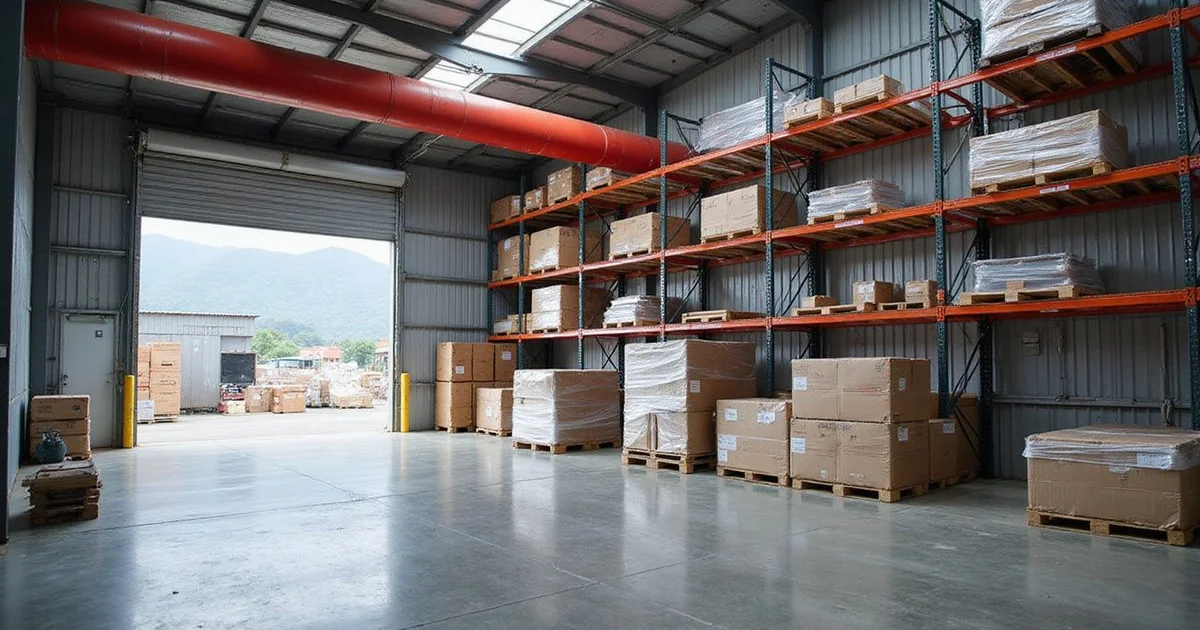
Fire Protection Is a Design Decision
Most SME owners we meet treat fire protection as a line item for the end of the project. It works far better as a design decision from day one.
Plan it alongside the height, racking and layout, and warehouse sprinkler requirements in Malaysia become much easier to manage. Get it wrong and you can hold up Bomba approval and the CCC, or pay for changes after the racking is in.
As the building arm of QDB Ventures Sdn Bhd, a Cheras-based contractor, we design fire protection into every warehouse construction project from the first drawing. The rulebook is the Uniform Building By-Laws 1984 (UBBL), amended in 2021. According to a 2026 IPM guide on sprinkler systems, sprinklers must follow By-law 228 and MS 1910.
Below, we cover the main fire protection items, when sprinklers are likely to be required, how Bomba reviews the design, and what it all does to your building.
The Main Fire Protection Items
A Malaysian warehouse can draw on six main fire protection items. The table shows what each one does and where the UBBL points to it.
| Item | What it does | Malaysian reference |
|---|---|---|
| Fire extinguishers | First response to small fires | UBBL by-law 227, placed along exit routes |
| Hose reels | Internal hoses for trained staff | 2021 amendment sets 30 m radial coverage per reel |
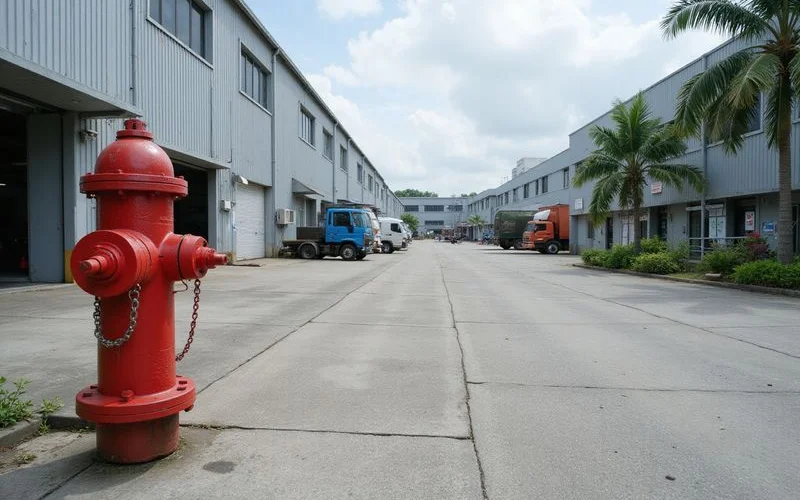
| Fire hydrants | External water supply for Bomba | By-law 225(2): at least one within 91.5 m of the fire brigade access point |
| Sprinkler system | Automatic suppression where required | By-law 228 and MS 1910 |
| Fire compartments | Walls and doors that limit fire spread | UBBL size limits, which can double with sprinklers (by-law 136) |
| Escape routes | Safe exits for people inside | Travel distances set in the UBBL Seventh Schedule |
Not every warehouse needs every item. The combination depends on the building and what is stored inside.
Hydrants are the item owners most often forget to budget for. The UBBL says no partial CCC can be issued until essential services such as the fire hydrant are completed, so a missing hydrant can hold up your handover.
When Sprinklers May Be Required
Sprinklers are more likely to be required as warehouses get bigger, taller and fuller of combustible goods. Under UBBL by-law 226, where storage is hazardous, an automatic system must suit the materials you keep. The main factors are:
- Building size and compartment area
- Storage height, which affects how fast fire spreads upwards
- Type of goods, with plastics, packaging and chemicals at higher risk
- Storage method, such as racking versus block stacking
Goods matter more than most owners expect. FactoryHub’s breakdown of the UBBL notes that a warehouse holding only non-combustible products, such as clay or bleaching earth, is treated far more lightly than one with combustible goods.
Volume matters too, not just floor area. According to FactoryHub, the 2021 Tenth Schedule uses cubic metres for warehouses, and a 1,000 m² warehouse at 7 m height already reaches 7,000 m³. Raise the roof by a couple of metres at the design stage and you may cross a threshold you didn’t plan for.
The exact requirement is confirmed during design against the applicable fire safety requirements, and Bomba reviews it as part of the building plan approval.
Why Storage Height Matters So Much
Fire in tall racking spreads upwards quickly and is hard to reach from the floor. As storage height rises, the fire protection needed can change, from ceiling sprinklers to higher sprinkler densities or in-rack protection. The IPM guide says early response heads, large droplet sprinklers or deluge systems may be proposed for these higher-risk cases, with the design depending on ceiling height, racking height and head type.
For a sense of scale, look at NFPA 13, the US standard that many designers use as a reference for storage. It asks for higher ceiling sprinkler densities where aisles are narrower than 2.4 m. It also limits K14 ESFR sprinklers to ceilings of about 10.7 m (35 ft) over rack storage unless in-rack sprinklers are added, according to the Society of Fire Protection Engineers (SFPE).
Malaysian designs run on MS 1910, so your fire engineer will confirm the design basis. The lesson holds either way: narrow aisles and tall racks push the cost up. That is why we link fire design to the racking plan. Our guide on warehouse clear height explains how height is chosen.
Tell us what you store
A clear description of your goods, packaging and storage height is essential for fire design.
How Bomba Reviews It
Bomba reviews the fire safety provisions on the building plans and inspects the completed building before the CCC. Their review covers access for fire engines, hydrant locations, escape routes and the internal systems. Early, complete fire design makes this review smoother.
Bomba expects two sets of drawings, passive and active. According to IPM’s guide to Bomba drawings, the active set shows the pipe connections from the pump room to the hose reel and sprinkler systems, plus the position and quantity of sprinkler heads.
Plan approval and the Fire Certificate (FC) are two separate steps:
| Stage | When it happens | Result |
|---|---|---|
| Bomba plan approval | During building plan submission, before construction | Approved fire safety plans |
| Fire Certificate | After the CCC, before occupation | Certificate valid for one year |
Enforcement is tightening. FactoryHub reports that in August 2025, JBPM said 9,321 premises nationwide were designated and 5,881 held an FC, with full enforcement due to start in the first quarter of 2026. JBPM’s director-general has also said Section 27A of the Fire Services (Amendment) Act 2025 means buildings that must hold an FC will need a fire safety manager structure in place.
Our guide on what Bomba, DOE and DOSH need from a new factory gives the wider picture.
The Knock-On Effects on the Building
Sprinklers bring their own needs: a water supply, often a storage tank and pump room, pipework under the roof that eats into clear height, and a roof structure that can carry the pipes. Hydrants need space around the building and a water main of the right size. These affect the layout, the structure and the budget, so they need to be in the design before the quotation.
The pump room is where owners are most often surprised. According to the IPM sprinkler guide:
- A typical set-up has one duty pump, one standby pump and a jockey pump to hold pressure.
- The standby pump needs a generator or diesel engine, with fuel for at least 4 hours at ordinary hazard or 6 hours at high hazard.
- The sprinkler tank should stand alone, not combined with the hose reel tank.
Each of these takes floor space on your land. Set that space aside early, and the site plan, tank position and fire engine access all fall into place without a redesign.
Getting It Right
Share your building size, storage height, racking and goods type early. Those four details drive your warehouse fire protection, from sprinkler needs to what Bomba will ask for.
We include fire protection in the detailed engineering and list the responsibilities for design, Bomba submissions and installation in the quotation. Send us your plot details and what you plan to store, and we’ll tell you which items to budget for before you commit to a layout.