
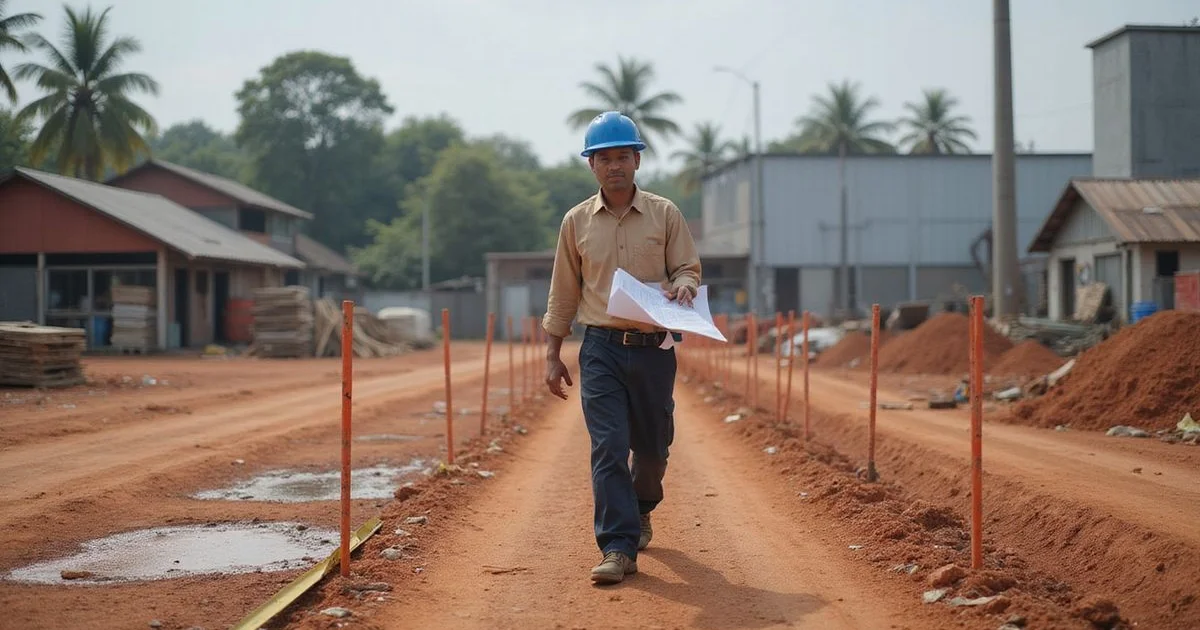
Check Before You Commit
Most factory budgets don’t go wrong in the steelwork. They go wrong in whatever nobody checked about the site.
That’s the job of a factory feasibility study. Before money goes into detailed design, it confirms that the land, the building you want and the budget all line up.
We’re the factory and warehouse building arm of QDB Ventures Sdn Bhd, a Cheras-based contractor that builds in Selangor. Our feasibility check is the first part of our factory construction planning service, and it reflects how Selangor councils, TNB and Air Selangor actually work.
Below, we go through the five site checks (land, size, soil, access, utilities) and then the budget that comes out of them.
Land and Zoning
Yes, if three things line up: your land title, the council’s zoning and the class of industry you plan to run. We check all three because they’re separate approvals, and the council that covers the site has the final say on planning.
- Land title: The category should say industry (Industri), not agriculture, and the express condition must allow your type of use.
- Council zoning: According to FactoryHub’s 2026 Selangor land guide, the local plan under the Town and Country Planning Act 1976 decides what the council will approve. It can refuse a factory on an industrial title if the zone is now planned for other uses.
- Industry class: Light, medium and heavy industry are not statutory title categories. A guide from klangindustrial.com notes that the class shows up in the title’s express conditions or the local plan, and the two don’t always match.
The stakes are real. FactoryHub’s due diligence checklist explains that a factory on land not approved for industry counts as an unauthorised factory (KTK) in Selangor, and the state’s compliance programme runs to 31 December 2027.
Our guide on building a factory on your land explains zoning in detail.
Building Size the Land Allows
Less than the plot size suggests, and setbacks decide how much less. Setbacks, site coverage and plot ratio limit the footprint and total floor area.
Plot ratio is simply total floor area divided by land area. Industrial Malaysia gives a useful example: on one acre (43,560 sq ft), a 40 ft front setback and 25 ft side setbacks can leave a maximum build-up of only about half an acre. Exact figures vary by council and plot type, so we work from the guideline that applies to your site.
We test your brief against these limits and show how much building fits, with space left for loading, parking and drainage. Run this check before you order equipment, not after.
Soil and Ground
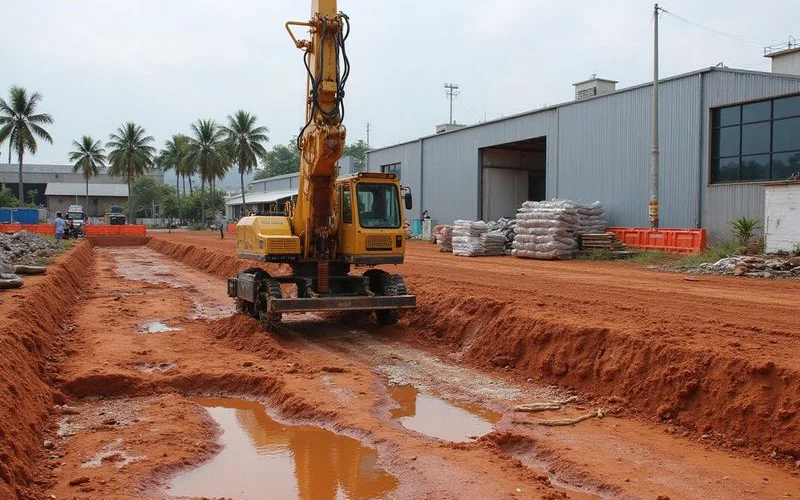
Ground conditions can move the budget more than any other item. Two Selangor examples show why:
- Soft coastal clay, as around Klang: May need deep piling. A 2003 paper by Gue & Partners on a 1,200-acre site at Bukit Tinggi, Klang, describes alluvial deposits of very soft to firm silty clay reaching 25 to 30 metres deep.
- Sloping land, as around Rawang: Needs earthworks and drainage.
We explain when soil investigation is needed and what it will show. In practice, a rig drills boreholes and takes samples at regular depths, so engineers know what the ground can carry. According to a 2010 study by Neoh cited by E-Geo Consultant, this work usually costs about 0.2% to 2% of total project cost. That’s a small price next to a piling surprise.
See soil investigation and piling.
Access
Yes, if your largest vehicle can enter the site and turn without blocking the road. We look at:
- Road widths on the approach
- Junctions near the site
- The site entrance
- Space for container lorries, if you use them
Land lost to setbacks, fire access and parking all compete for the same space, as FactoryHub’s 2026 Selangor land guide points out. Plan lorry turning space early, because squeezing it in later usually means cutting into building area.
Power and Water
Usually yes, but the size of your load decides how much work it takes. We look at the likely TNB supply needs from your equipment, whether a substation might be required, and Air Selangor water and sewerage connections.
TNB’s Electricity Supply Application Handbook (ESAH 3.1) sets the thresholds by maximum demand:
| Maximum demand | What TNB’s handbook says |
|---|---|
| Up to 100 kVA | Supply from the existing low-voltage network, subject to a TNB study |
| Above 100 kVA to 350 kVA | Underground cable from a feeder pillar or substation, after a TNB system study |
| Above 350 kVA to 1,000 kVA | Direct cable from a new substation |
| 1,000 kVA and above | 11 kV supply, with your own transformers and switchgear |
Above 350 kVA (about 505A at 400V), a new substation is needed. A 2026 FactoryHub cost guide says that can take 3 to 12 months and that you provide the land and building for it. Know this before you fix your build programme.
On water, Air Selangor treats and distributes water across Selangor, Kuala Lumpur and Putrajaya. Sewerage is run separately by Indah Water Konsortium (IWK). If your process needs a lot of non-drinking water, ask about reclaimed supply: Air Selangor and IWK announced a joint venture in 2021 to pipe treated, non-potable water to industrial users.
What a Feasibility Check Covers
Six items, and each one answers a question you’d otherwise find out the expensive way. Here is the full list.
| Item | Question answered |
|---|---|
| Zoning | Is my activity allowed here? |
| Size allowed | How big can I build? |
| Soil | What foundations might I need? |
| Access | Can my vehicles get in and turn? |
| Power and water | Is supply available, and what will I need? |
| Budget | What should I prepare for? |
Find the deal-breakers first
The point of feasibility is to find problems while they are cheap to solve, or before you buy the land.
The Indicative Budget
The check ends with an indicative budget prepared from your brief. It is not a published rate, so treat it as a planning range.
We flag items that are still uncertain so you know where the budget may move:
- Piling: Hard to price until soil investigation is done.
- Substation: Needed above 350 kVA, and it takes land, building space and months of lead time.
- TNB connection charges: A 2026 FactoryHub cost guide, citing TNB’s connection charge book, puts low-voltage charges between RM4,050 (61 to 90 kW) and RM38,250 (721 to 850 kW).
- Earthworks and drainage: Likely on sloping land.
As the design and engineering progress, the budget firms up into the quotation.
Next Step
Gather what you already have, then send it over. Our guide on what to send your contractor has a checklist, and missing details are fine.
A land title, a rough equipment list and the vehicles you use are a good start. With those, we can run your factory feasibility study and tell you early what fits, what it needs and where the budget may move.