
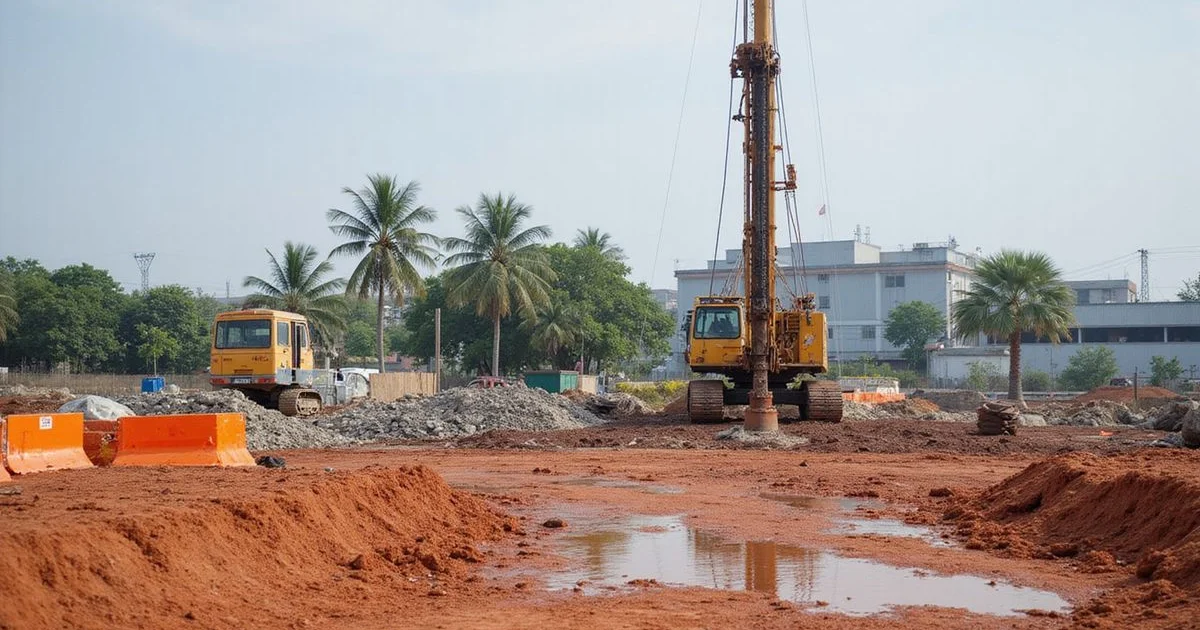
Ground Is the Biggest Unknown
You know how two factories of the same size can come back with very different foundation prices? The ground is usually the reason.
Foundations are the hardest line in a factory budget to predict before work starts. Two identical buildings can need very different foundations, depending on what lies under the site.
That’s why soil investigation and piling for factory projects sit at the centre of our civil and infrastructure works. As a Cheras-based contractor, we ask owners to commission soil investigation early, before the design and budget are fixed.
Here’s the plan. We’ll cover what soil investigation tells you, how piling works, what soft clay in Klang and sloping land in Rawang do to a budget, and how all of it shows in a quotation.
What Soil Investigation Does
Soil investigation (SI) drills boreholes and tests the ground to find out four things:
- What the soil layers are and how strong they are
- How deep firm ground lies
- Where the groundwater is
- How much the ground may settle under load
The workhorse test in Malaysia is the Standard Penetration Test (SPT). Under ASTM D1586, a crew drives a sampler into the ground with a 63.5 kg hammer dropped about 760 mm, and counts the blows. More blows mean firmer ground.
For softer sites, SI specifications in Malaysia commonly add rotary boring, piezocone tests and field vane shear tests. These give a clearer picture of clay strength than blow counts alone.
The engineers use the results to choose the foundation type, design the piles if needed, and set the floor slab design. Without SI, the foundations are designed on assumptions, and the budget carries more risk.
Piling and Pile Caps
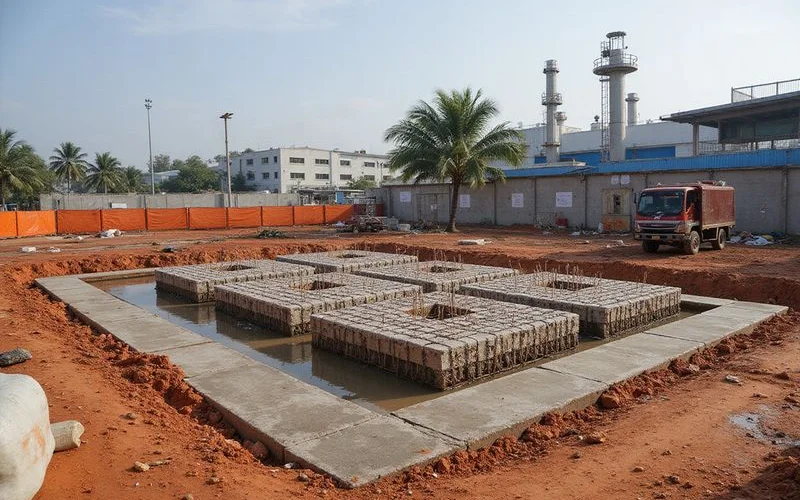
Where the surface soil is too weak to carry the building, piles take the loads down to firmer layers. Groups of piles are joined at the top by pile caps, which carry the columns. On soft ground, the floor slab itself may need piled support to avoid settlement under racking and machinery.
Engineers at Gue & Partners, who have published widely on Klang clay, list three problems that piled foundations on very soft clay are designed against:
- Excessive differential settlement
- Negative skin friction, where settling clay drags down on the piles and uses up part of their capacity
- Bearing capacity failure
Negative skin friction is the one owners rarely hear about. It’s also why pile length is a design decision and not a guess.
Soft Clay on the Klang Coast
Much of the coastal land around Klang and Port Klang is soft clay. On this ground, piles often need to go deeper to reach firm layers, and more of the building, including the floor, may need piled support.
How deep is deep? A Gue & Partners study at Bukit Tinggi, Klang, found very soft to firm silty clay down to 25 to 30 m, with sandy layers in between. The same study found that clay strength rises almost linearly with depth below a stiffer surface crust, so the firm layer can sit a long way down.
Piling can become one of the biggest items in the budget. It is the main reason two warehouses of the same size can cost very differently, and it’s why factory piling cost swings more on soft clay than on any other ground type.
Two things are worth asking about before you commit to a soft clay foundation in Klang:
- Is the slab piled or ground-bearing? A slab laid on fill sinks with the clay, while a piled slab does not.
- How will the yard and apron be treated? A Klang industrial guide by engineer Jason Low points to a step between the apron and the loading bay as the classic sign of a yard settling at a different rate from a piled building.
Earthworks on Sloping Land
On hillier ground, such as parts of Rawang, the challenge shifts from depth to shape. Forming a level platform needs cut and fill, new slopes need to be stable, and drainage has to handle faster runoff (see our guide to industrial land drainage and retention ponds). Fill areas may need careful compaction or deeper foundations. SI still matters, both for the building and for the slopes.
Malaysian practice gives some firm reference points. The JKR Guidelines for Slope Design (2010) require stability analysis for cut and fill slopes. JKR’s geotechnical criteria also call for settlement analysis on fills, and prefer to take fill material from adjacent cuts where possible, which keeps haulage costs down.
Gue & Partners notes that a vertical interval of about 5 to 6 m between berms (the flat steps in a slope) is usual in Malaysia. On a steep site, those berms take up land you might have wanted for the building or the yard.
| Ground type | Main cost effect |
|---|---|
| Soft coastal clay | Deeper or more piles, piled floors |
| Sloping land | Earthworks, slopes, drainage |
| Filled ground | Compaction, possible deeper foundations |
| Firm ground | Simpler foundations |
Spend a little early to avoid a lot later
Soil investigation is a small share of a project. Industry guides commonly put it at well under 1% of total project cost. The certainty it gives the foundation design is usually worth far more.
How This Shows in a Quotation
Before SI, piling and earthworks are often carried as provisional items, estimated and then measured. After SI, they can be priced with more confidence. That’s the main reason a quotation firms up once soil investigation in Malaysia is done properly.
Our quotations spell out three things:
- What we’ve assumed about the ground
- How provisional quantities are measured
- Who commissions the SI
We do not publish figures, because ground varies too much between sites. A number from one Klang plot tells you very little about a plot a few kilometres away.
For the full picture of what moves a factory budget, read factory construction cost in Malaysia. For how the floor is affected, read warehouse floor loading.
Own a plot in Selangor and weighing up a build? Send us the lot details, and we’ll tell you what soil investigation to commission first and what it should cover.