
Rain Is a Design Load
If you own industrial land in Selangor, drainage is one of the first things to get right. A big roof and a paved yard turn most of the rain that lands on them into runoff, and Malaysian rain is heavy and sudden.
When drainage can’t cope, yards flood, loading bays fill with water and neighbouring land suffers. In April 2025, The Star reported that heavy rain from 2am left two dead and almost 1,000 displaced in Selangor, with parts of Shah Alam and Klang hit.
We treat drainage as a core part of our civil and infrastructure works. Factory Builder Malaysia, the factory and warehouse building arm of QDB Ventures Sdn Bhd, builds in Selangor, so the industrial land drainage requirements below are the ones we meet on real sites.
Here’s what we’ll cover: how site drainage works, when a retention pond is needed, what councils ask for, and how to plan it all together.
Site Drainage Design
A factory site drainage system collects water from three places and carries it off the land:
- The roof, through gutters and downpipes
- The yard and roads, through falls, channels and gullies
- The platform edges and slopes, through perimeter drains
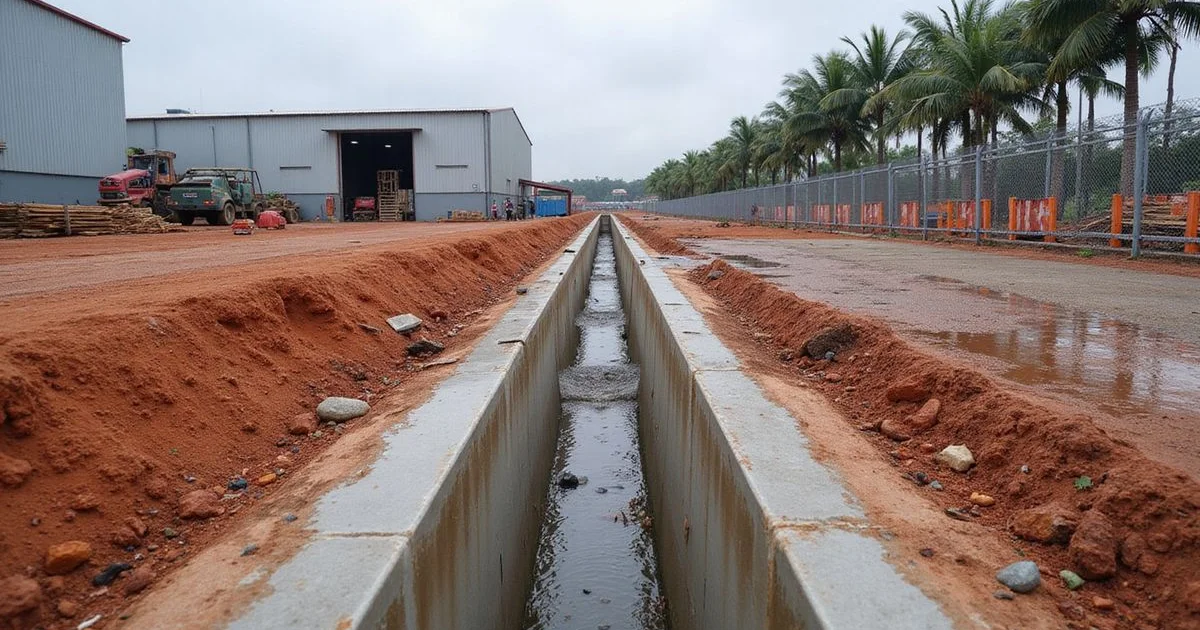
The water then goes to the council drain, often through a monsoon drain along the boundary. That’s the large open drain your site connects into. The Department of Irrigation and Drainage (JPS) lists monsoon drains among the standard drainage structures in its Urban Stormwater Management Manual, known as MSMA.
Drains are sized for the area they serve and the intensity of rain expected. MSMA (2nd edition, 2012) picks a design storm by its average recurrence interval, or ARI. A 100-year ARI storm has a 1% chance of happening in any given year, so ask your designer which ARI each drain is built for.
Retention Ponds
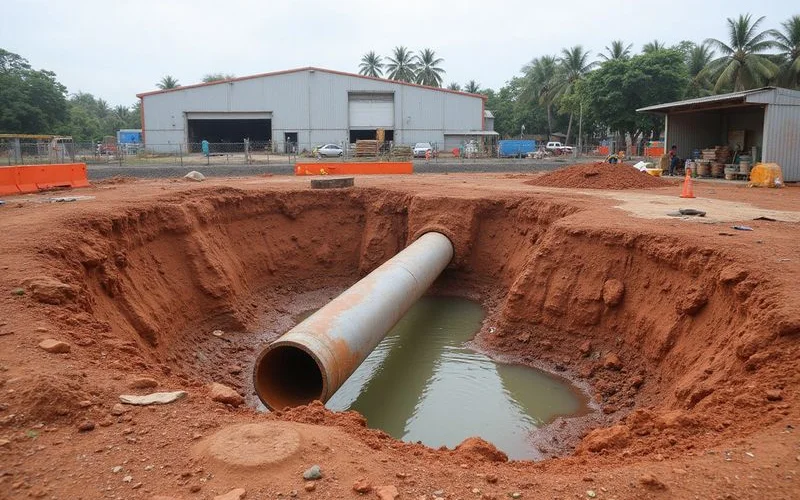
When a site is developed, rain that used to soak into the ground runs off much faster. A retention pond (or detention facility) holds back some of that water and releases it slowly, so the drains downstream are not overwhelmed. Councils may require one, depending on the site and the area.
| Site factor | Effect on drainage |
|---|---|
| Large roof and yard | More runoff to handle |
| Sloping land | Faster runoff, more erosion risk |
| Flood-prone area | Stricter outlet controls |
| Small, flat site | Simpler drainage, pond less likely |
If your retention pond industrial site plan goes ahead, MSMA sets some clear design points:
- Emergency overflow: the secondary outlet must safely pass at least a 100-year ARI storm.
- Side slopes: flatter than 1 vertical to 6 horizontal is recommended, and slopes steeper than 1 to 4 may need a fence or rail.
- On-site detention tanks: storage volume is estimated using a 10-year ARI storm.
Land take is the question most owners ask. MES Innovation, a Malaysian stormwater consultancy, notes that Peninsular Malaysia has no single pond-sizing rule, and local authorities set their own. It cites a JPS suggestion of at least 3% of the project area, with post-development flow not exceeding pre-development flow. On a one-acre lot, that’s roughly 120 square metres, so confirm the real figure with your council early.
Treat pond land as working land, not spare land. In May 2026, Federal Territories Minister Hannah Yeoh said Kuala Lumpur City Hall will not approve planning permission on retention pond land until JPS conditions are met. At the Jinjang and Batu ponds, development cut capacity from 114.5 hectares to 34.35. A task force will also engage Selangor counterparts.
Council Requirements
Your local council sets the drainage requirements for your site, such as MBSA in Shah Alam, MBDK in Klang, MPKj in Kajang or MPS in Rawang. Expect them to cover:
- Drain sizes
- Outlet points
- Any retention requirement
- Erosion control during construction
Drainage plans form part of the submissions. JPS publishes a stormwater management submission checklist, and it’s worth asking your consultant to work from it. It calls for an Erosion and Sediment Control Plan (ESCP) for both the pre-bulk grading and post-bulk grading stages, so earthworks planning starts before the first excavator arrives.
Drainage sets the levels
Platform levels, floor levels and yard falls all depend on where water must go. Drainage is planned first, not last.
Flood and Runoff Risk
Poor drainage causes problems inside and outside the site:
- Water entering the factory
- Damaged yard pavements
- Silt washing into neighbouring drains
- Slopes eroding
On hillier land, such as parts of Rawang, earthworks and drainage are a bigger share of the job because water moves faster. MSMA’s erosion control chapter says sediment basins must be built before clearing and grading begins. A basin dug after the first heavy storm is too late.
Planning It With the Site
We design drainage, platform levels and roads together, so water flows the right way and the yard stays usable in heavy rain. This approach also avoids the costly fix of re-cutting levels after the drains are in.
For the yard itself, see roads and hardstanding. For ground conditions, see soil investigation and piling.
Have a plot in Selangor and a rough layout in mind? Send us the site details, and we’ll check the factory site drainage, outlet point and any monsoon drain connection before the levels are fixed.